9mm Vs .380 caliber - Which One Is Good For Concealed Carry?
If you're deciding between 9mm and .380 ACP, you're not alone. These two handgun calibers remain the most popular choices for concealed carry, everyday carry (EDC), and personal defense.
While both fire the same diameter bullet (.355"), they differ significantly in power, recoil, magazine capacity, firearm size, ammunition cost, and terminal performance.
This updated 2026 guide compares every major factor to help you choose the right caliber for your needs. Modern defensive ammunition has improved .380 ACP performance, but 9mm still generally offers greater energy and wider ammunition availability.
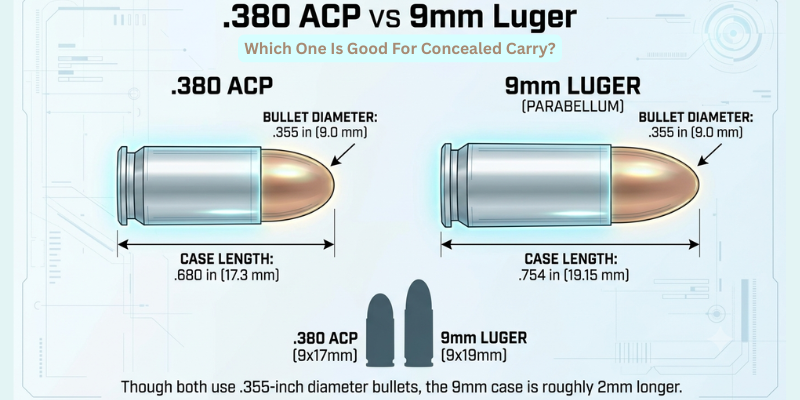
That's why we are going to compare 9mm vs 380 caliber.
This will be exciting to know what is the difference between both & why some people love to use 380 rounds over 9mm rounds.
To move further in this blog post, check out our previous 9mm comparison guides with other popular calibers like; 5.7 Vs. 9mm, 9mm Vs. 10mm, 45 Vs. 9mm.
9mm vs .380 caliber :Cartridge Specifications
| Specifications | 380 Ammo | 9mm Ammo |
| Designed by | John Browning | Georg Luger |
| Year of Design | 1908 | 1901 |
| Production | 1908–present | 1902-Present |
| Bullet Weight | 90 to 100 grains | 100 to 150 grains |
| Case Type | Rimless, straight | Rimless, Tapered |
| Bullet Diameter | .355 in (9.0 mm) | 0.355 inches (9.01mm) |
| Neck Diameter | .373 in (9.5 mm) | 0.380 inches (9.65mm) |
| Case Length | .680 in (17.3 mm) | 0.754 inches (19.15mm) |
| Case Capacity | 11.8 grains h20 | 13.30 grain H20 |
| Overall Length | .984 in (25.0 mm) | 1.169 inches (29.69mm) |
| Maximum Pressure | 21,500 psi (148 MPa) | 241.3165 MPa (35,000.00 psi) |
380 Ammo Overview
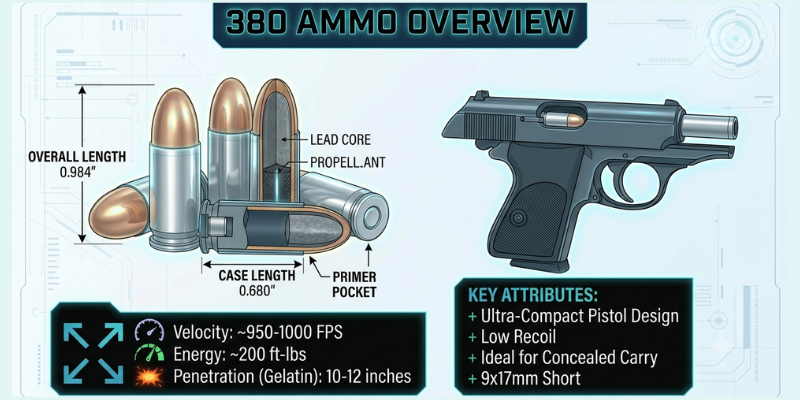
The .380 ACP, also known as the 9mm Browning, 9mm Short, and 9mm Kurtz, is a rimless, straight-walled pistol cartridge.
The .380 ACP is compact and light but has a shorter range and less stopping power than other modern pistol cartridges.
As there are many other popular calibers available in the market, 380 ammo is still popular for shooters who want a lightweight or smaller pistol with manageable recoil.
The .380 ACP is a strong contender for those seeking less recoil, ease in concealed carry, and an effective overall round.
9mm Ammo Overview
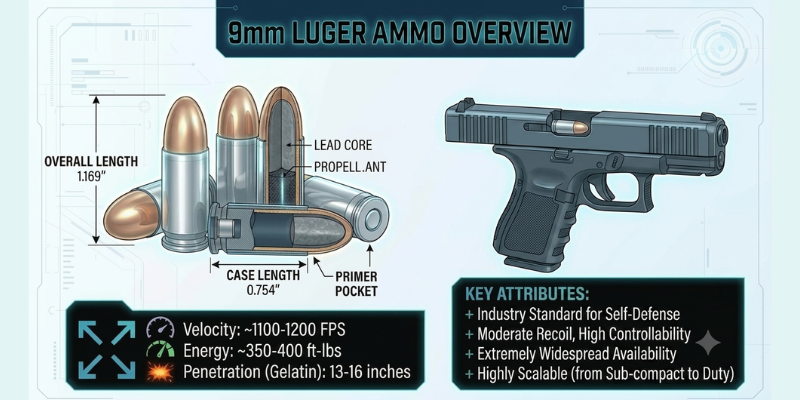
The 9mm ammunition is the king of the calibers when it comes to handgun loads.
It’s reliable, low recoiling, and extremely accurate. This is the main reason why the U.S. military, FBI, other government agencies, state, county, and local law enforcement, and countless civilian shooters rely on the round.
We have already discussed 9mm calibers in our previous blog post.
9mm vs .380 caliber : Bullet Weight & Size
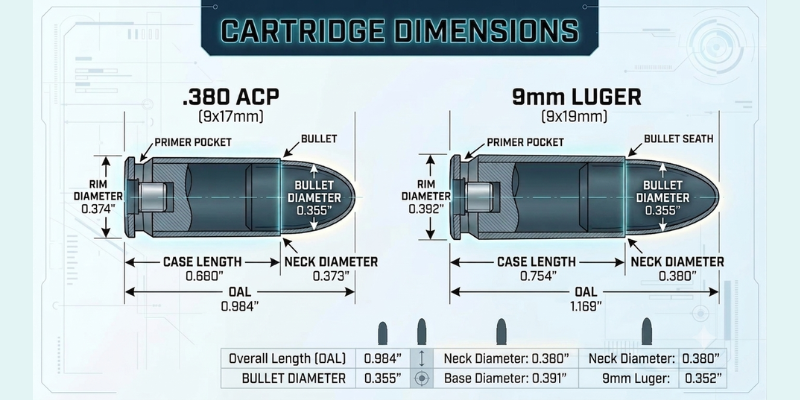
When we compare 9mm & 380 calibers by size, the diameter of a 9mm bullet is 9.01mm, while the .380 ACP has a diameter of 9.0 mm.
So, both calibers have the same diameter, but the 9mm casing and overall length are longer than 380 ACP.
This means there is more gunpowder in the 9mm casing, which is more powerful & often chosen for its better penetration and energy transfer.
It's a popular choice for self-defense and law enforcement.
On the other hand, the .380 ACP is smaller and may have less recoil, making it a more comfortable option for some shooters, especially in compact or subcompact firearms.
The typical bullet weights for .380 ACP range from 85 grains to 95 grains, while 9mm can vary more widely, ranging from about 90 grains to 147 grains.
.380 Vs. 9mm: Stopping Power
As per the stopping power, 9mm calibers have higher velocity & energy, which is helpful for better stopping power.
On the other hand, 380 ACP has lower velocity and energy compared to 9mm.
380 Vs. 9mm: Recoil
Recoil is one of the most important factors to consider while choosing a caliber. When we compare .380 Vs. 9mm by recoil, this is the point that some people prefer .380 over 9mm.
As this cartridge is shorter, lighter, and less powerful, it has milder recoil.
Milder recoil allows for more accurate follow-up shots because you need less time for sight recovery.
This can be an advantage for individuals with limited hand strength or those who are new to shooting.
On the other hand, 9mm handguns have more recoil. But modern 9mm handguns often feature recoil-reducing technologies that are helpful in making them more comfortable to shoot.
380 Vs. 9mm: Accuracy
When we talk about the accuracy between 380 & 9mm, 380 cartridges have the advantage of being more accurate because of their less recoil.
The lighter recoil of the .380 ACP makes it more manageable for rapid-fire situations.
It allows shooters to maintain better control and stay on target during consecutive shots, which can be crucial in self-defense scenarios where quick follow-up shots might be necessary.
380 Vs. 9mm: Penetration
Bullet design and ammunition choice can significantly impact penetration. In general, the 9mm tends to have better penetration capabilities compared to the .380 ACP.
This is because the 9mm typically has higher muzzle energy and a larger bullet, which can result in better penetration through barriers such as clothing, glass, or other materials.
380 Vs. 9mm: Ballistics
In terms of ballistics, the 9mm Luger is the best option over 380 ACP. Because of its additional 2 mm of case length, the 9mm is the bigger cartridge and, therefore, has higher muzzle energy and muzzle velocity and will penetrate deeper than almost every .380 ACP on the market.
.380 ACP Ballistics
Note: This information is based on the specific manufacturer or brand. Please make sure to check the latest information from a brand before buying.
This ballistics test was conducted with Hornady 90-grain XTP & a handgun that comes with a barrel length of 4 inches.
| - | Muzzle | 25 Yds | 50 Yds | 100 Yds |
| Velocity (FPS) | 1,000 | 953 | 913 | 846 |
| Energy (FT/LB) | 200 | 181 | 167 | 143 |
| Drop (Inch) | - | 0“ | -1.6″ | -12.8″ |
9mm Ballistics
The ballistics of 9mm ammunition can vary depending on the specific load and manufacturer. But there are some important points you need to take care of while calculating ballistics, like Muzzle velocity, Energy, Penetration, Recoil & bullet weight.
For 9mm ballistics, we have a dedicated blog post. To know the complete information about 9mm ballistics check here.
So, as per the ballistics comparison between 9mm & 380 ACP, the 9mm generally offers better ballistic performance and stopping Power.
.380 Vs. 9mm: Price & Availability
Price
For the price comparison, 9mm ammo is affordable because of its high demand compared to 380.
9mm ammo approximate Per Round Cost: 0.16 To $3.70 for 50 rounds of box. (at the time of writing this post)
On the other hand, 380 ammo is more expensive than 9mm because of the smaller market demand.
Availability
One of the most widely used calibers globally, so it's usually more readily available. You can find 9mm ammunition in various brands and types in most gun stores.
380 ammo might still be a bit less available compared to 9mm, especially in times of increased demand.
Most Asked Questions About 9mm vs 380 Caliber
Is .380 ACP weaker than 9mm?
Ans: Yes. .380 ACP is generally less powerful than 9mm Luger because it has a shorter case and holds less gunpowder. This results in lower muzzle velocity and less muzzle energy.
Can I shoot .380 ACP in a 9mm handgun?
Ans: No. Although the bullets have the same diameter, .380 ACP and 9mm Luger are different cartridges. The .380 ACP case is shorter and designed for different chamber dimensions and operating pressures.
Which caliber has more recoil?
9mm produces noticeably more recoil than .380 ACP. The increased velocity, heavier bullet weights, and higher operating pressure of the 9mm generate a stronger recoil impulse.
Which caliber is cheaper?
Ans: 9mm is almost always the more affordable option. Because it is one of the world's most widely produced handgun cartridges, manufacturers produce 9mm ammunition in massive quantities, keeping prices competitive.
Which caliber is better for women?
Ans: Many women successfully carry and train with 9mm because it offers: Greater terminal performance, Lower ammunition cost, More firearm options and higher magazine capacity in many pistols. However, .380 ACP may be a better choice for those who: Have limited hand strength, Prefer a lighter-recoiling pistol, Need an easier-to-rack slide & want a smaller firearm for concealed carry.
Which caliber is better for pocket carry?
Ans: .380 ACP generally has the advantage for true pocket carry. Modern micro-compact 9mm pistols have narrowed the size gap considerably, but .380 ACP still remains one of the easiest calibers to carry discreetly in a pocket-sized handgun.
Why do most law enforcement agencies carry 9mm instead of .380 ACP?
Ans: Because 9mm offers the best balance of power, capacity, and reliability. Modern 9mm duty ammunition consistently penetrates deeper and expands more reliably than most .380 ACP loads, while also allowing officers to carry more rounds in the same-sized pistol. It is also cheaper for training, which means agencies can afford more practice and qualification sessions.
Is .380 ACP enough for self-defense?
Yes—when paired with quality defensive ammunition and accurate shot placement, .380 ACP can be an effective self-defense cartridge. Modern hollow-point designs have significantly improved the cartridge's terminal performance compared to older ammunition.
Final Words
Finally, after a complete discussion about 9mm vs 380 caliber, we can say that — both calibers are popular choices for self-defense rounds.
When it comes to choosing between the 9mm and .380 calibers, 9mm is more popular but we can’t ignore the 380 caliber. There are many shooters who love to choose 380 over 9mm.
The 9mm is a versatile and powerful cartridge that is well-suited for a variety of purposes.
At the same time, the .380 is a compact and lightweight option that can be easily carried for personal defense.
Always choose the caliber that fits your needs & requirements.